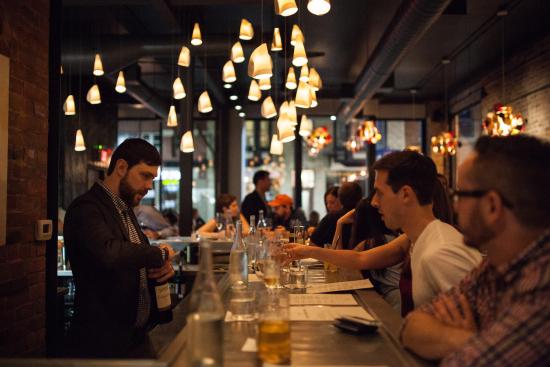
Over the past few months, the odds of finding me habitually thriving off leftover Indian or Szechuan have been a little too high. The refined palette I once spoiled with game meats, artisanal mustards, and wild fish (I never stopped drinking good wine, however…priorities) has dwindled down to papadum and these things I keep calling “chocolate beans” from this Sri-Lankan place I really like on Dalhousie.
Decidedly, a couple of weeks ago, I finally ended my whirlwind relationship with Styrofoam containers. One of my nearest and dearest convinced me that after a long hiatus from writing, and a not-so-long hiatus from take out, I should make an effort to go to the Château du Trignon Winemakers Dinner and get the old dusty wordpress flowing again. Curiosity got the best of me, and on April 27th, a Monday (aka Saturday ha), I found myself sitting in the stone cellar of my favourite neighbour, Fauna.
Fauna, one of Ottawa’s youngest in the restaurant family, is home to one of the more innovative kitchens. Their dishes are incredibly intricate, politely portioned, and are rich in earthly ingredients. It’s sort of to say that the ingredients have an innate rustic palate, yet the dinner menu plating would speak more to the intricate plating of say, Benu, in San Francisco. Well worth the wait.
On this evening, I joined an intimate group of wine and food lovers. I became quickly acquainted to my immediate neighbours and I spotted some familiar faces. Led by Fauna sommelier Alex McMahon, we were all cordially introduced to Jean-Louis Smyl, export manager for the Quiot family, and more specifically, Château du Trignon wines.
Jean-Louis is a rosy-cheeked and unbearably charming gentleman of Rhône, France. He needed very little lead in order to draw the long table into his story and the history of each of the 6 Château du Trignon wines we sipped that evening. The feast we were about to embark on reminded me of exactly why I first fell in love with food and wine culture: the intimacy of sharing a meal. I adore the concept of breaking bread with others, sharing the experience, letting a drink or two (or six in this case) flow through you and loosen up your tongue. Telling stories of adventures, the dish in front of you, and a glass of wine over a hundred years in the making. Vineyards are incredible when you think about it. The complexity of a terroir, how it affects each layer of aroma and flavour, and how sometimes ancient vines exist to create beautiful wines each year. It completely blows my mind. But I digress; the meal was about to begin.
As Jean-Louis concluded his introduction to the first wine, a lovely, floral and off-dry Côtes du Rhône rose, and we turned to the other side of the room to see chef John Svazas. The room is filled with quick working and silent servers who delicately drop an intricately plated small dish in front of each guest. Chef Svazas introduces his foie gras. This dish is a play on peanut butter and jam; a seared foie gras, complimented by a soft peanut butter powder, a Syrah-strawberry jam and rhubarb. The rhubarb adds a subtle bitterness, and the jam a tanginess, which balances the dish that would otherwise be insanely rich with the peanut butter and foie. The rose heightened the jam, rhubarb, and strawberry components, rinsing the palette and preparing it for luxurious smoothness of the foie. It was the most deluxe PB & J I’ve ever fooled with.
Round 2. At this point I’ve decided that every penny I scrimped up to go to this dinner was completely worth it. At first I was skeptical, which is often my neutral demeanor, but after the first course, reading (and beginning to experience) the menu, and noticing that these tasting pours were more than three ounces, I started to vibe with it. There was no loss here.
Jean-Louis chimes up once again, raises a glass of Côtes du Rhône Marsanne, and introduces us to a wine with a sturdy but lighter body, hints of macadamia, pear, and honey. He chuckles again with a hearty accent and we begin our second course.
Chef returns once again with his band of ninja-esque servers (I swear my glass wasn’t empty once for even a second) and explains our halibut dish. Course two is very delicate and well complimented by the Marsanne. The halibut is accompanied by a sunchokes, lemon, and white soy. As much as I often fond over seafood dishes, this course didn’t catch my eye as much as the rest of them did. Although it was completely delicious and matched the wine perfectly, it went past me pretty quickly.
Okay I’ve had a few glasses. I’m in a great mood. My best friend is sitting across from me with her partner, and they’re both trying to explain some sort of new-fangled technology to me. It’s a bluetooth flash…thing…and it results in a really funny, red-eyed, blushing picture of me at the dinner. Needless to say, the smirk in my picture speaks volumes. I’m a happy camper.
Round 3! We are introduced to the first red wine of the evening, a Sablet. Deriving its name from the sandy area in which the village resides, Sablet was granted status as a Côtes du Rhône Villages in 1974. Sablet is most known for reds, often blends of Grenache, Mourvedre, Syrah, and Cinsault. This Sablet wine is jammy, light-to-medium bodied, very light anise on the nose, with hints of deep red fruits, currents, and earth.
Course three is quail. I’ve always loved quail. I think there’s something really entertaining about eating a tiny bird. I’ll add that to the list of things I find entertaining and that my vegan/vegetarian friends don’t, right next to gutting fish.
The quail is light and crispy on the skin, and tender within (haha rhyme). It’s cooked perfectly, however, it’s not the most interesting element on the plate. There’s this thin ribbon placed diagonally across the left side of the dish. It was inevitable, someone at the end of the table chimed up and asked how on earth it was made. Chef explains that it’s a sort of fruit leather made with cassis, a French black currant liqueur. Beneath the quail we find chef’s play on a soubise, traditionally a buttery onion sauce. He uses leek and fennel, which gives more depth to the soubise and compliments the wine better than I imagine the original soubise would. The sweetness of the currant leather, paired with delicate tones of fennel and licorice and tartness of cranberry, tamed the gamey quail and flattered the Sablet flawlessly.
The courses have grown in depth and heaviness. We began with a small but rich plate, and moved up in weight. Foie gras, halibut, quail, and now, lamb.
With the lamb we are introduced to two different wines in which to pair our lamb that is cooked in two separate ways on our plate. One wine is a Vacqueyras, which I admit I have never had, and the other is a Gigondas. Jean-Louis and chef Svazas both invite us to choose our pairings. One piece of lamb is done sous-vide, medium-medium rare, and is melt-in-your-mouth. This is the lamb I preferred and chose to pair it with Vacqueyras. The full dish consists of a dense, rich tartlet, poblano harissa (a poblano chili pepper paste), lamb kafta, an aioli, capers, olives, and anchovy. The lamb-two-ways dish is abounding in Mediterranean influence. I’m a big fan of Syrah, so I’m ultimately a big fan of Côtes du Rhône wines, period. The Gigondas paired better, in my opinion, with the lamb kafta, as it had slightly spicier notes that complimented the light char of the lamb. The richness of the Vacqueyras pairs best with the tender sous-vides lamb. Vacqueyras uses more Syrah than Gigondas tends to, and is dark and inky in colour. It’s playfully known as the younger sibling of Chateauneuf-du-Pape, although it certainly shouldn’t reside in its shadow.
Finally, we reach dessert. A dear friend of mine Sarah Farmer runs the dessert program here at Fauna, each piece is nothing short of a masterpiece, and tonight’s is no exception. A geometrical angel food cake is laid down in front of us. A sugar glass circle and whimsical painting of each element on the plate invoked a childish giddiness inside me (I swear, it wasn’t just the wine). The elements of our dessert included bee pollen, orange blossom, apricot, honey, and rosewater. Paired with a Muscat from Beaumes de Venise, a lovely fortified wine with honeyed notes and a bit of acidity to compliment Sarah’s dessert.
As the event ends, the room does anything but wind down. We begin to chat about our experience, start to branch off to other parties (it’s rather early in the evening for anyone who works late night), and chef’s night at Oz Kafe is down the street. I met a few other wine fanatics, namely Andrew Rastapkevicius, aka Andrew Rasta, who’s blog, Capital Wine, is informative, passionate, and down to earth. I highly recommend any wine enthusiast check it out. Andrew also represents Lifford Wines, and if there are any enquiries on purchasing Château du Trignon wines, get a hold of him.
I spend the rest of my evening slurping back a dry martini or two at Oz Kafe, and brainstorming how I’ll ever write this up.
To eat and sip at the one and only Fauna:
425 Bank St
Ottawa
613-563-2862
Instagram: @faunaottawa
To order or follow wines of notable caliber:
Andrew Rastapkevicius
Instagram: @andrewrasta

 sedimental value
Leave a comment